
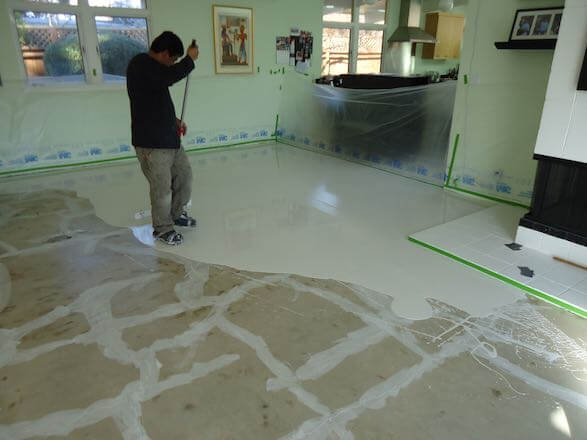
The slab is spalled, the broom finish has worn smooth in the traffic lanes, and the surface looks tired next to the rest of the property — but the concrete underneath is still sound. Tearing it out and re-pouring is the expensive answer. A polymer modified overlay is usually the better one. J&C Concrete Restorations Inc has been installing decorative and structural concrete finishes across Napa and the wider North Bay since 2014, resurfacing patios, pool decks, entries, and interior floors with a cementitious topping that bonds tight and can be finished any way you want it.
What polymer modified overlay installation involves
A polymer modified overlay is a cement-based topping with polymer resins blended into the mix. Those polymers are what give it excellent adhesion to existing concrete along with high tensile and fractural strength — properties ordinary concrete topping mixes don’t have at thin cross sections. That’s why an overlay can go down over a worn slab and stay there instead of delaminating.
The work starts with the substrate, not the topping. We mechanically profile the existing concrete by grinding, which also removes old paint, sealer, epoxy, or carpet glue that would block the bond. Cracks and spalled areas get addressed. On interior floors where elevations are off or the slab has dips and humps, we use a self-leveling underlayment first to correct the surface before any decorative layer goes down.
Then the overlay itself is placed and worked with squeegees and steel trowels. That tooling is where the finish is decided: a steel-troweled pass can replicate the look of freshly poured concrete, while squeegee and trowel texturing produces knockdown and broom-style surfaces with more grip for a Napa pool deck or patio. Integral color can go into the mix, and reactive or non-reactive stains can be applied over the cured overlay for depth and variegation. The slab gets sealed to finish.
Why J&C Concrete for polymer modified overlay installation
- Working in decorative and structural concrete since 2014, with a portfolio that runs from commercial projects in Silicon Valley to high-end residential work across Northern California.
- A small, principal-involved company. Jose and Carlos are on the jobs — overlay work is trowel-dependent, and the finish is only as good as the hands holding the tool.
- Full surface prep in-house. We grind and profile the slab ourselves and strip old coatings, paint, and glue, so the bond isn’t a gamble on someone else’s prep.
- Self-leveling underlayment when the slab needs it, so uneven interior floors get corrected before the decorative layer instead of telegraphing through it.
- Color and finish worked out together. Integral color, reactive stains, non-reactive stains and dyes, and blended layering techniques all combine with an overlay — we’ll show you samples before we commit the floor.
- 5.0 stars across 69 Google reviews, with a referral-based and ever-increasing client list.
Our polymer modified overlay process
- Free on-site estimate. We walk the slab in Napa, check for cracking, moisture, coatings, and drainage, and confirm an overlay is the right call rather than grinding and polishing the existing slab.
- Finish selection. You pick texture and color direction — smooth steel-troweled, knockdown, or textured — along with integral color and any stain treatment.
- Surface preparation. Mechanical grinding to profile the concrete, removal of old paint, epoxy, sealers, and adhesives, and treatment of cracks and spalled areas.
- Leveling, if required. Self-leveling underlayment corrects dips, humps, and elevation changes on interior floors.
- Overlay placement. The polymer modified mix is placed and worked with squeegees and steel trowels to build the specified texture.
- Color and detail work. Reactive or non-reactive stains, blended layering, and any saw-cut or border detailing.
- Seal and cure. The finished surface is sealed, and we review cure times and care before we leave the site.
What polymer modified overlay installation typically costs
Overlay estimates range based on square footage, the condition of the existing slab, and how much finish work the design calls for. The biggest cost driver is almost always prep: a clean, sound patio needs far less than a slab carrying old epoxy, thinset, carpet glue, or a heavily spalled surface. Self-leveling underlayment adds material and labor when interior elevations need correcting. On the decorative side, a single integral color with a simple troweled texture sits at the low end, while multi-layer stain blending, borders, and saw-cut patterns sit higher.
Compared against demolition and re-pouring, an overlay avoids costly tear-out, hauling, and disposal on a slab that’s still structurally fine — which is the main reason Napa homeowners choose it. Estimates include prep, the overlay system, finishing, and sealing. We’ll give you the number in writing after we’ve seen the slab; request a free estimate and we’ll come measure.
Service areas we cover
- Napa
- Vallejo — including polymer modified overlay installation in Vallejo
- Benicia
- Fairfield
- Vacaville
- Santa Rosa
- Petaluma
- Sonoma and Solano counties
- The greater San Francisco Bay Area
FAQ
Will an overlay fix a cracked slab?
An overlay resurfaces and renews the wearing surface. Cracks are addressed during prep, but an overlay is a topping, not a structural fix — if the slab is moving or has failed subgrade, that’s a different conversation and we’ll tell you straight during the estimate.
How thin does a polymer modified overlay go?
Thin. That’s the point of the polymer modification — the resins provide the adhesion and tensile strength that let a cementitious topping perform at a fraction of the thickness of a new pour, so door clearances and thresholds usually stay workable.
Can it go on an exterior patio or pool deck in Napa?
Yes. Polymer modified overlays are used to resurface worn interior and exterior slabs, and textured trowel or squeegee finishes give exterior surfaces grip. Coloring and stain work hold up well on decorative exterior concrete surfaces throughout the North Bay.
Overlay or epoxy — which should I choose?
Epoxy is a resin coating and is our go-to for garages and interior spaces that need chemical and impact resistance. An overlay is cementitious, so it reads and wears like concrete and works better outdoors and where you want a troweled or textured concrete look. We’ll match the system to the space during the walkthrough.
Can you remove the old coating that’s already on my slab?
Yes — our grinding equipment removes paint, epoxy, sealers, and carpet glue as part of surface prep.
Do you do commercial overlay work?
We do. Our portfolio includes commercial projects across the Bay Area alongside high-end residential work, including winery, showroom, and warehouse floors.
If you’ve got a worn patio, pool deck, entry, or interior slab in Napa and you’d rather resurface than replace, let’s look at it. Call J&C Concrete Restorations at (707) 307-6984 or (707) 402-9864, or email jose@jcconcreterestorationinc.com or carlos@jcconcreterestorationinc.com to request your free estimate. We’ll walk the slab, talk through finish options, and put a real number in front of you.