
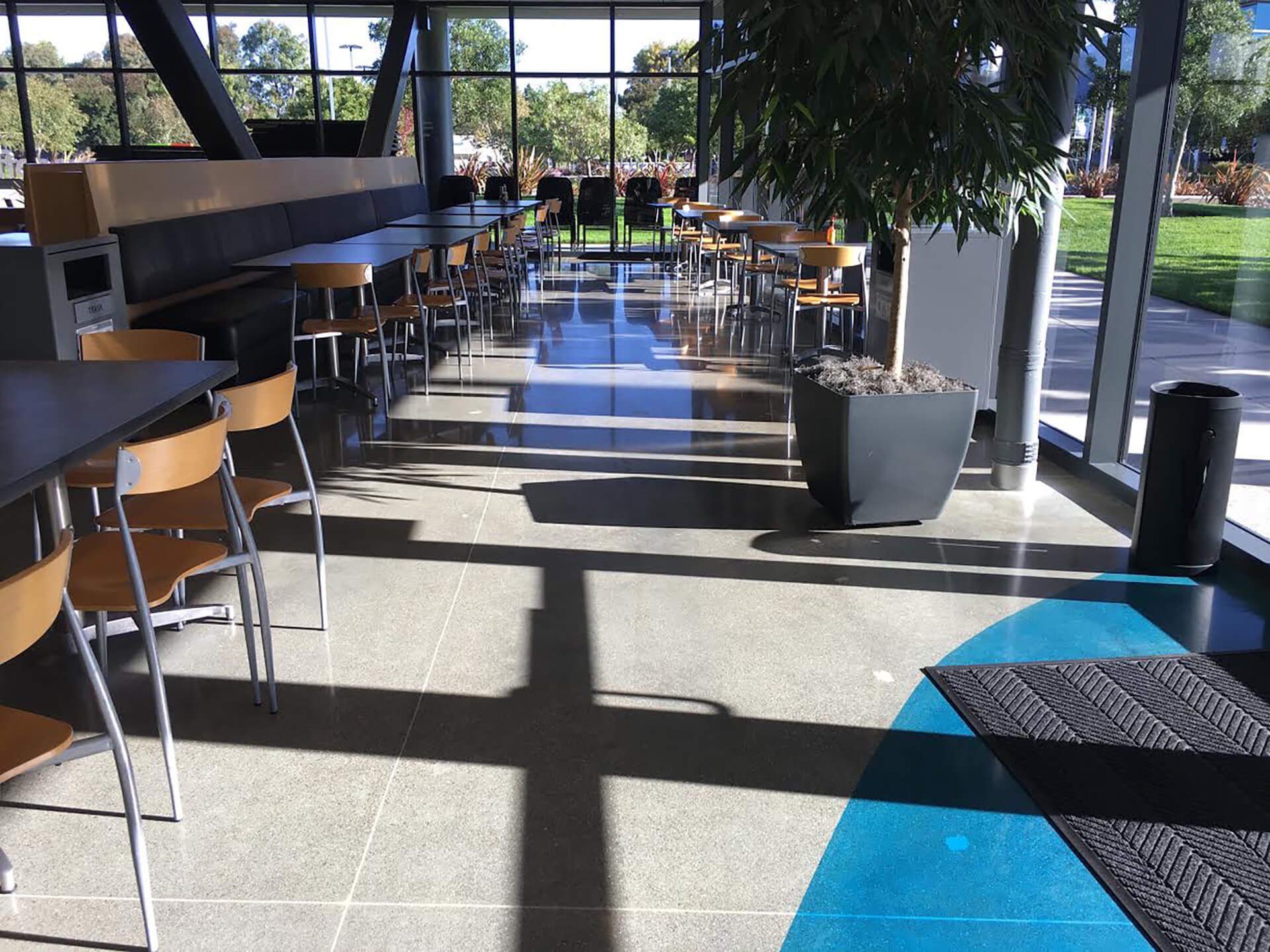
You have a slab under that carpet, tile, or flaking old paint — and you’re wondering whether it can become the finished floor instead of the thing you cover up. In most Santa Rosa homes, tasting rooms, and shops, it can. Polished concrete grinds the existing slab down with progressively finer diamonds until the surface itself is the finish: hard, light-reflective, and easy to maintain. J&C Concrete Restorations has been doing decorative and structural concrete work across the North Bay since 2014, and polishing is one of the finishes we know best.
What polished concrete floor installation involves
Polishing is a mechanical process, not a coating. We run walk-behind and edge grinders fitted with diamond tooling across the slab in a sequence of grits, each one refining the scratch pattern left by the last. The first pass does the demolition work — it removes old coatings such as paint, epoxy, and carpet glue, and it opens the slab.
How deep we grind on that first pass determines the look. A light cut leaves a cream finish with only occasional sand visible. A deeper cut exposes the aggregate-filled surface, giving you that terrazzo-like field of stone throughout. That decision is made on your slab, with you, after we see what’s actually in the concrete — every pour is different.
From there the options branch. A grind-and-seal is faster and less expensive: we grind to a chosen grit and apply a sealer for the sheen and protection. A true mechanical polish continues through fine grits with a densifier hardening the surface, producing gloss that comes from the concrete itself. Color can be introduced with reactive or non-reactive stains before polishing, and dyes can be blended for multi-colored polished floors. If the slab has elevation problems, we correct with self-leveling underlayment first.
Why J&C Concrete for polished concrete floors in Santa Rosa
- Working decorative concrete since 2014 — over 10 years of grinding, staining, and coating slabs across Northern California, from Silicon Valley commercial jobs to high-end residential.
- Small, principal-involved crew. Jose and Carlos are on the jobs. You aren’t handed off to a rotating subcontractor after the estimate.
- Grind level chosen on-site, not sold in advance. Cream, salt-and-pepper, or full aggregate exposure — we test-cut and show you what your slab will actually look like before committing.
- We handle removal, not just polishing. Old epoxy, paint, thinset, and carpet glue come up as part of the grinding sequence.
- Color capability beyond gray. Reactive stains, non-reactive dyes, and blended layering can all be built into a polished floor for wine-country interiors that need warmth.
- 5.0 stars across 69 Google reviews, with a referral-based client list.
Our polished concrete process
- Free estimate visit. We come to the Santa Rosa property, look at the slab, check for coatings, cracks, and elevation changes, and talk through what finish you’re after.
- Test grind. On most jobs we cut a small area to reveal what aggregate is in the concrete and how it will read at different grit levels.
- Prep and containment. Furniture and fixtures out, plastic and dust containment up, adjacent surfaces protected. Grinders run on vacuum extraction.
- Coating removal and first cut. Coarse metal-bond diamonds take off old finishes and establish the exposure level.
- Patching and densifying. Cracks, pop-outs, and pinholes are filled to match, then a densifier is applied to harden the surface for the fine grits.
- Color, if specified. Reactive stain or dye is applied and worked to the pattern you approved.
- Finish polish and seal. Resin-bond diamonds through the final grit for your chosen sheen, then a guard or sealer, then a walkthrough with you before we pull the containment.
What polished concrete floors typically cost
We don’t publish a per-square-foot number, because the slab decides most of the price. Estimates range based on square footage, how much old material has to come off, the condition of the concrete, the grit level and sheen you want, whether color is involved, and how much edge and detail work the room has.
Costs come down on open floors with clean, sound concrete and no coatings — a warehouse or a new-construction interior polishes efficiently. Costs go up when we’re removing carpet glue or a failed epoxy, patching extensive cracking, correcting elevation with self-leveling underlayment, or working around cabinetry, columns, and tight rooms where hand edging replaces machine time. A grind-and-seal will always be less than a full mechanical polish, and a single stain color less than a blended multi-color floor.
If your slab has damage too widespread to polish through, concrete resurfacing in Santa Rosa is usually the more sensible path — we’ll tell you that at the estimate rather than after. Estimates and consultations are free.
Service areas we cover
We polish floors throughout the North Bay and the greater Bay Area, including:
- Santa Rosa
- Petaluma
- Sonoma and the surrounding valley
- Napa
- Vallejo
- Benicia
- Fairfield
- Vacaville
Homeowners and property managers elsewhere in the county can also read about our concrete polishing services across Sonoma County, and commercial clients can review our commercial polishing work in Solano County.
Frequently asked questions
Polished concrete vs epoxy — which is better?
They solve different problems. Polished concrete is the slab itself, so there’s no coating to peel or delaminate, and it handles UV and heat well — good for interiors, showrooms, and tasting rooms. Epoxy adds a new layer over the slab and hides surface defects, which makes it a better fit for garages and shops where oil, chemicals, and hot tires are the concern. If your concrete is sound and attractive, polish it. If it’s stained and pitted, coat it.
Can you polish a slab that has old epoxy or carpet glue on it?
Yes. The coarse grinding stage is designed to remove old coatings including paint, epoxy, and carpet glue. It adds time and cost to the job, but it’s routine work.
Will cracks still show after polishing?
Cracks are filled and color-matched as closely as possible, but polishing is transparent — it reveals the slab honestly rather than hiding it. Many clients like the character. If you want cracks gone visually, a polymer modified overlay resurfaces the slab instead.
How long does a polished concrete floor last?
Because the finish is mechanical rather than applied, a polished floor lasts as long as the slab does with routine dust mopping and neutral-pH cleaning. Sheen can be refreshed by re-burnishing years down the road without replacing anything.
Can polished concrete be colored?
Yes — reactive stains create variegated, earth-toned results by reacting with minerals in the concrete, while non-reactive stains and dyes fill surface pores and offer a broader, more vibrant palette. Both can be layered or blended.
How disruptive is the work?
Grinders run on vacuum extraction and we set dust containment, but it’s still a mechanical process in an occupied space. We’ll give you a realistic room-by-room schedule at the estimate.
Get a free polished concrete estimate in Santa Rosa
If you’re deciding whether your Santa Rosa slab is worth polishing, the fastest answer is a walkthrough. We’ll look at the concrete, tell you what exposure level it will support, and give you a written estimate at no cost. Call J&C Concrete Restorations at (707) 307-6984 or (707) 402-9864, or email jose@jcconcreterestorationinc.com to schedule a free consultation.