
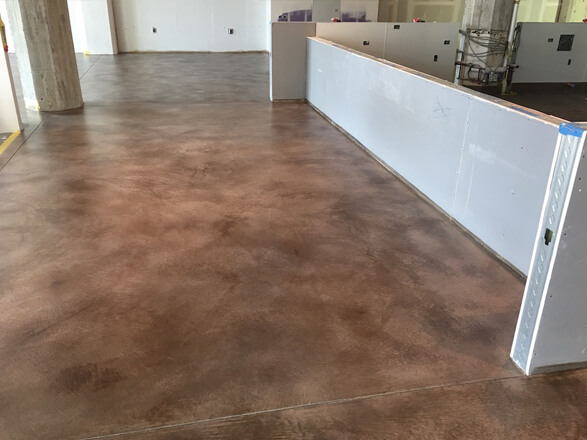
That gray slab off your Benicia patio door — sun-bleached, blotchy from years of planter pots and barbecue grease — doesn’t need to be torn out. It needs color that lives inside the concrete instead of sitting on top of it. J&C Concrete Restorations Inc has been staining residential and commercial concrete across the North Bay and greater Bay Area since 2014, using reactive chemical stains and non-reactive dyes to turn tired slabs into floors with depth and character. Jose and Carlos are on the job, on your slab, hands on the trowel.
What concrete staining involves
Staining is a coloring process, not a coating. Reactive stains — the acid-based chemistry most people picture when they think of stained concrete — react with the free lime and mineral content already in your slab. The color that comes out is variegated, earth-toned, and genuinely one of a kind, because it’s driven by how your particular concrete was poured, finished, and cured. Two Benicia driveways poured the same year will not stain identically, and that’s the point.
Non-reactive stains and dyes work differently. They fill the surface pores with pigment rather than reacting chemically, which opens up a much broader and more vibrant color palette — blues, deep charcoals, saturated reds — that reactive chemistry simply can’t produce. On many jobs we blend the two: layering stains, mixing colors, or combining reactive and non-reactive methods to get a custom result that suits the room or the yard.
A typical job starts with mechanical surface prep. Old sealers, paint, mastic, and carpet glue have to come off, and the profile has to be open enough to take color evenly. We grind, clean, apply and neutralize the stain, then seal. On exterior Benicia slabs facing full afternoon sun and Carquinez wind, sealer selection matters as much as color selection.
Why J&C Concrete for concrete staining
- Working decorative and structural concrete in Northern California since 2014, with a portfolio spanning commercial floors in Silicon Valley and high-end residential work in the North Bay.
- Both reactive and non-reactive systems in house, plus blending techniques — so the recommendation is based on your slab and your color goal, not on the one product we happen to stock.
- A small, principal-involved shop. The people who quote your Benicia project are the people who prep and stain it.
- Full grinding capability, including removal of old paint, epoxy, and carpet glue before any color goes down — the prep step that decides whether a stain looks intentional or splotchy.
- If your slab is too far gone to take stain cleanly, we can install a polymer modified overlay first and stain the new surface instead of tearing out and re-pouring.
- 5.0 stars across 69 Google reviews, from a client list that has grown almost entirely by referral.
Our concrete staining process
- Free estimate and slab assessment. We look at the concrete in person — its age, finish, existing coatings, cracking, moisture behavior, and how much mineral content it likely has to react with.
- Color direction. We talk through reactive versus non-reactive, single color versus layered blend, and what the finish will look like against your Benicia home’s existing hardscape, cabinetry, or wine-room finishes.
- Sample application. Where the project warrants it, we stain a test area on your actual slab. Chips and photos only go so far; your concrete decides the final color.
- Mechanical prep. Grinding to remove sealers, paint, epoxy, or adhesive residue and open the surface profile. Cracks and defects addressed so they don’t telegraph through the color.
- Stain application. Reactive stain is applied and allowed to react, then neutralized and thoroughly rinsed. Dyes are applied and worked for even coverage. Layered blends go on in sequence.
- Seal and protect. Sealer chosen for the exposure — interior traffic, exterior UV, pool deck slip resistance — and applied in coats.
- Walkthrough and care instructions. We show you the finish, explain cure times, and cover cleaning and resealing intervals.
What concrete staining typically costs
Staining is usually one of the more economical decorative options per square foot, because you’re coloring the slab you already own rather than covering or replacing it. Estimates range based on square footage, how much prep the slab needs, whether old coatings or adhesive have to be ground off, whether you want a single reactive color or a layered multi-color blend, and which sealer the exposure calls for. Interior floors that are already clean and uncoated sit at the low end. Exterior patios with old sealer, oil staining, and heavy sun exposure sit higher.
Costs climb when the slab needs correction first — self-leveling underlayment for uneven interior elevations, or an overlay to give the stain a sound surface. What’s included in a J&C estimate: prep, stain, neutralizing and rinse, and sealer. Furniture moving, landscaping protection, and structural repairs are quoted separately if needed. Call for a free on-site estimate and we’ll price your actual slab, not an average.
Service areas we cover
- Benicia
- Vallejo
- Fairfield
- Vacaville
- Napa
- Santa Rosa
- Petaluma
- Solano, Napa, and Sonoma counties
- Greater Bay Area
FAQ
Can you stain a driveway or patio that’s already been sealed?
Yes, but the old sealer has to come off first. We grind the surface to remove sealer, paint, or epoxy so the stain can reach the concrete. Skipping this step is the single most common reason a stain job looks patchy.
Reactive stain or dye — which should I choose?
Choose reactive if you want mottled, natural, earth-toned variation that looks like the color belongs to the stone. Choose a non-reactive stain or dye if you want a specific, consistent, or vivid color the acid palette can’t reach. On many Benicia projects we combine both.
Will staining hide cracks and stains in my existing concrete?
No. Stain is translucent and follows the character of the slab, including cracks and discoloration. If the slab is badly damaged, a better route is resurfacing the slab with an overlay and then staining the fresh surface.
How does stained concrete compare to polished concrete?
Polishing mechanically refines and densifies the slab, exposing aggregate and producing sheen. Staining adds color. They’re frequently combined — many polished concrete floors in North Bay homes and wineries are stained before the final polishing passes.
How long does stained concrete last?
The color is permanent — reactive stain is chemically part of the slab, and dyes sit inside the pores. The sealer is the wear layer, and periodic resealing keeps the finish looking right, more often on exterior slabs than interior ones.
Do you stain commercial floors?
Yes. Tasting rooms, showrooms, retail, and offices throughout Solano, Napa, and Sonoma counties.
If you’re weighing concrete staining for a Benicia patio, garage, tasting room, or interior floor, get a real look at your slab before you decide. Call J&C Concrete Restorations at (707) 307-6984 or (707) 402-9864, or email jose@jcconcreterestorationinc.com to request a free estimate. We’ll walk the concrete with you and tell you honestly whether staining, an overlay, or polishing is the right call.