
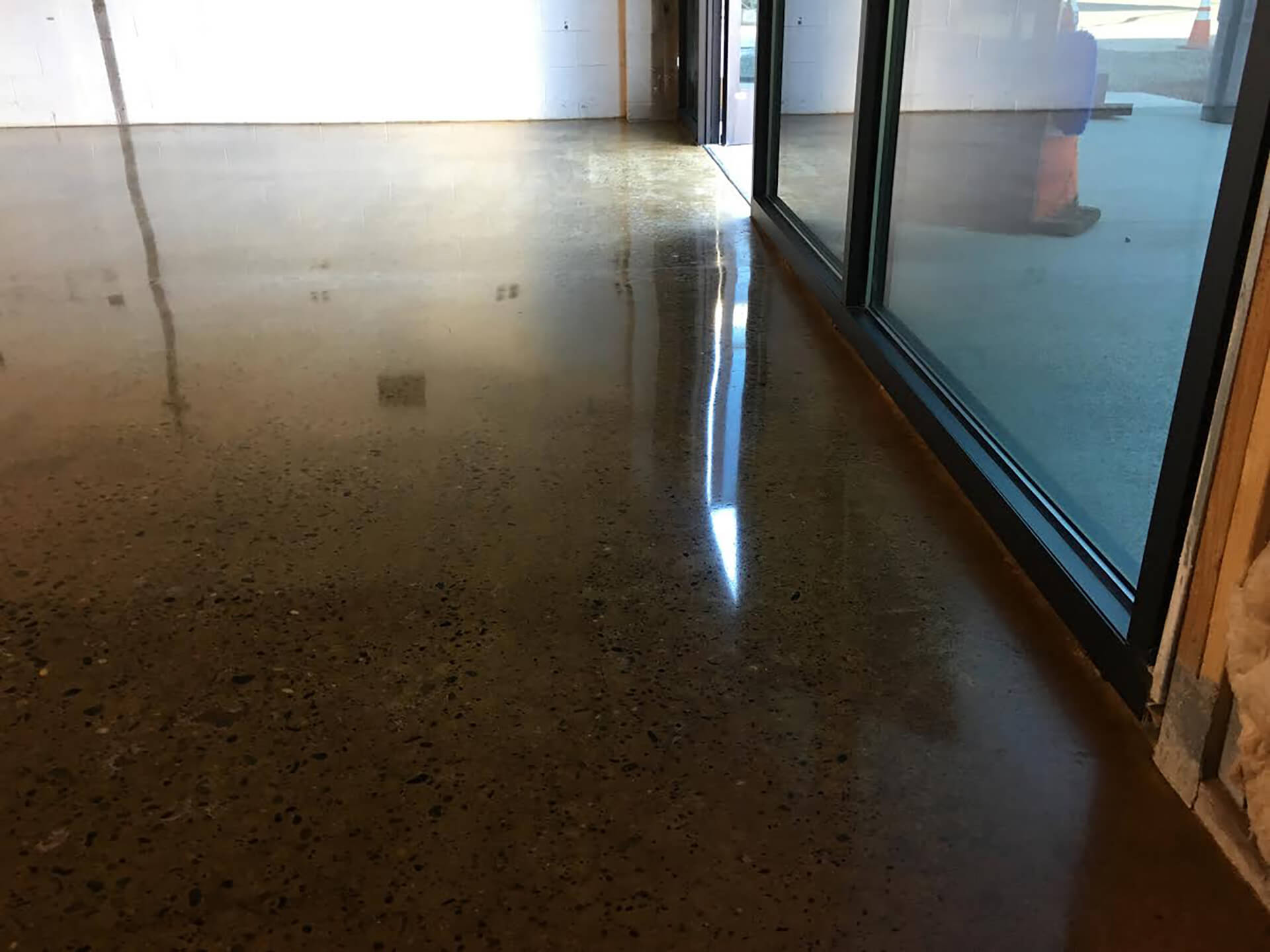
That slab under your carpet glue, flaking paint, or tired old epoxy is usually the best floor in the building — it just hasn’t been opened up yet. Concrete polishing grinds away the failed surface, refines the slab with progressively finer diamonds, and leaves a hard, light-reflective floor that doesn’t peel because there’s nothing sitting on top of it to peel. J&C Concrete Restorations Inc has been doing decorative and structural concrete work across Northern California since 2014, and polished concrete is one of the finishes we recommend most often to Fairfield homeowners and commercial property owners.
What concrete polishing involves
Polishing is mechanical, not a coating. We run walk-behind and ride-on grinders fitted with diamond tooling across the slab, starting with coarse metal-bond segments and stepping up through finer resin-bond diamonds until the surface reaches the sheen level you’ve chosen. The first passes do the heavy lifting: removing old paint, epoxy, mastic, carpet glue, and surface contamination, and flattening out trowel marks and high spots.
How aggressively we grind determines the look. A light pass keeps a cream finish with minimal stone showing. Grinding deeper exposes the aggregate-filled surface underneath — the salt-and-pepper sand particles or, deeper still, the larger stone. That decision is permanent, so we make it together before the first machine touches the floor.
From there the options fork. A grind-and-seal is faster and less expensive: we grind to the exposure you want, then apply a topical sealer. A true multi-step polish continues through the finer grits with a densifier hardening the surface chemically along the way, ending in a burnished finish that comes from the concrete itself. We also stain during the process — reactive stains for variegated earth tones, or non-reactive dyes for a broader, more vibrant palette — for multi-colored polished floors. Slab condition, existing coatings, and moisture all get checked first.
Why J&C Concrete for concrete polishing in Fairfield
- Decorative and structural concrete work since 2014, with a portfolio that runs from commercial projects in Silicon Valley to high-end residential floors across the Bay Area.
- A small, principal-involved company — the people who quote your Fairfield floor are the people running the grinders on it.
- Full coating removal capability: old paint, failed epoxy, carpet glue and mastic come off with the diamond tooling rather than being covered up.
- The full decorative range in-house, so if grinding reveals a slab that polishes poorly, we can pivot to a polymer modified overlay or a chip system instead of forcing the wrong finish.
- Reactive and non-reactive staining, plus blending techniques, integrated into the polish for color that lives inside the floor.
- 5.0 stars across 69 Google reviews, and a referral-based client list that keeps growing.
Our concrete polishing process
- Free on-site consultation. We look at the slab in Fairfield, test a small area where we can, and discuss aggregate exposure, sheen level, and whether polishing or a coating is the better answer for that floor.
- Written estimate. Scope, grit sequence, exposure level, stain or no stain, and sealer or densifier finish — all spelled out before work is scheduled.
- Prep and containment. Furniture and fixtures out, edges and adjacent surfaces protected, dust extraction set up so grinding stays contained.
- Coating removal and rough grind. Metal-bond diamonds strip old epoxy, paint, or glue and flatten the surface to the agreed exposure.
- Patch and densify. Cracks, pop-outs, and pinholes get filled, then a densifier is applied to harden the surface for the refining passes.
- Refining passes and color. Progressive resin diamonds bring the sheen up; stains or dyes are applied at the appropriate stage if you’ve chosen color.
- Seal, burnish, and walkthrough. Final protection goes down, the floor is burnished, and we walk it with you and cover maintenance.
What concrete polishing typically costs
Polished concrete is priced per square foot, and estimates range based on a handful of real variables. The biggest one is what’s currently on the slab: bare concrete grinds fast, while thick epoxy, tile mastic, or carpet glue adds removal passes before polishing even begins. After that it’s the number of grit steps — a grind-and-seal costs less than a full multi-step polish to a high sheen. Aggregate exposure matters too, since deeper stone exposure means more aggressive cutting. Add staining, blending, or crack and spall repair and the number moves up. Small residential rooms carry a higher per-foot rate than an open Fairfield warehouse or showroom because setup and edge work don’t scale down.
What’s included: prep, containment, grinding, densifying, refining, and the final seal or burnish. Not included: moving heavy fixtures, and any substrate correction we can’t see until the coating comes off. We give free estimates, and we’d rather look at the slab than guess over the phone.
Service areas we cover
- Fairfield
- Vacaville
- Vallejo
- Benicia
- Suisun City
- Napa
- American Canyon
- Petaluma
- Santa Rosa
- Greater Bay Area and Northern California
FAQ
Polished concrete vs. epoxy — which is better for my floor?
Polished concrete is the slab itself, so it can’t delaminate and it holds up under forklifts, foot traffic, and UV. Epoxy adds a color layer and hides slab imperfections that polishing would put on display. For showrooms, wineries, retail, and modern interiors, polishing usually wins. For a garage where you want a specific color and slip texture, our vinyl chip epoxy system in Fairfield is typically the better fit.
Can you polish a slab that has old epoxy or carpet glue on it?
Yes. Removing paint, epoxy, and carpet glue is part of the grinding sequence. We take it back to raw concrete first, then evaluate what the slab looks like underneath before choosing the exposure level.
What if my concrete is cracked or badly worn?
Cracks and pop-outs can be filled and polished through, though they’ll still read as part of the floor’s character. If the slab is too far gone to polish attractively, we resurface instead — see our concrete resurfacing work for what that involves.
How dusty is the grinding?
We grind with dust extraction and containment. It’s not a zero-dust process, but interior polishing in occupied Fairfield homes and businesses is routine work for us.
Can polished concrete be colored?
Yes. Reactive stains react with the minerals in the concrete for variegated, one-of-a-kind earth tones. Non-reactive stains and dyes fill the surface pores and offer a broader, more vibrant palette. We also layer and blend both methods for custom multi-colored polished floors.
How do I maintain a polished floor?
Dust mop regularly and damp mop with a pH-neutral cleaner. No stripping, no waxing. We cover maintenance specifics for your finish at the final walkthrough.
If you’re weighing polished concrete for a garage, living space, winery, showroom, or warehouse floor in Fairfield, let’s look at the slab together. Call J&C Concrete Restorations Inc at (707) 307-6984 or (707) 402-9864, or email jose@jcconcreterestorationinc.com to request a free estimate — we’ll tell you honestly whether polishing is the right finish for your floor before you spend a dollar.